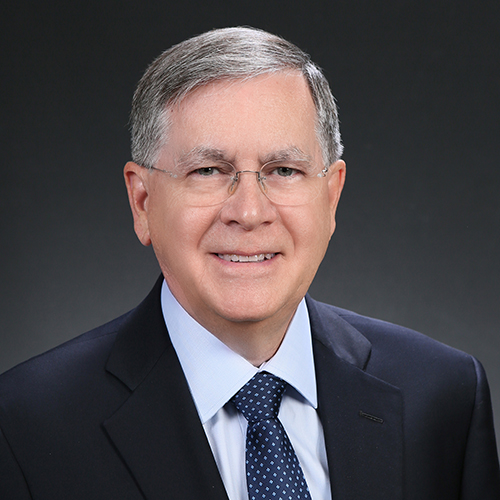
The Honorable David M. Satterfield is the director of Rice University’s Baker Institute for Public Policy. He has more than four decades of diplomatic and leadership experience, including service as special envoy for the Horn of Africa, assistant secretary of state, National Security Council staff director and as ambassador to Lebanon and Turkey and charge d’affaires in Iraq and Egypt. In October, 2023 he was appointed Presidential Special Envoy for Middle East Humanitarian Issues to lead US diplomacy in addressing the humanitarian crisis in Gaza. In April, 2024 he stepped down from this role and continues to serve as a Consultant to the Department of State.
Satterfield’s extensive bilateral and multinational negotiating background most notably includes the 1995 Roadmap for Israel-Palestinian Peace (with the United Nations), the 2000 withdrawal of the Israel Defense Forces from Lebanon and Blue Line boundary agreement (with the United Nations), and the 2008 Status of Forces Agreement between the U.S. and Iraq. As the State Department’s coordinator for Iraq, he managed the largest domestic staff in the department’s history and directed fundamental reforms to the Foreign Service.
As director general of the Multinational Force and Observers, Satterfield conceived and directed the comprehensive modernization of military and civilian peacekeeping operations and led fundraising efforts with the U.S. Congress and donor governments.
Among other honors, Satterfield is the recipient of the highest Department of State recognition, the Secretary of State Distinguished Service Award, the highest award for senior federal executives, the Office of Personnel Management Distinguished Federal Executive Rank Award, and the highest Department of Defense award for career federal civilians, the Secretary of Defense Medal for Meritorious Civilian Service.
Satterfield is a Member of the American Academy of Diplomacy.
Satterfield is a graduate of the University of Maryland and speaks Arabic, French and Italian. He is married to Elizabeth Ann Fritschle, a career Foreign Service officer.